Can the anion gap assist determine the reason of acid-base imbalance?
What is the anion gap?
The anion gap is a computed value that helps clinicians read an electrolytes panel and evaluate acid-base balance. It compares the main reported positive ions and negative ions in blood, especially sodium, chloride, and bicarbonate. Because not all ions are measured directly, the result provides a valuable diagnostic clue about whether there may be excess acids or other unmeasured anions in the bloodstream.
At its core, the anion gap shows the difference between measured cations and measured anions. In routine practice, it is most often used as part of a broader electrolyte panel review when evaluating metabolic acidosis or other forms of systemic acidosis. A normal value points to one pattern of clinical interpretation, while an elevated value points toward another. The number itself does not make the diagnosis, but it supports narrow the differential diagnosis.
Think of the anion gap as a view of the chemical balance in the blood. If bicarbonate falls, something else must often be taking its place. That “something else” may be acids that do not show up on a standard panel. The resulting gap calculation can support a workup, but it must always be read alongside the patient’s symptoms, history, and other laboratory values.
How the anion gap calculator operates
An Anion Gap Calculator handles the usual formula used to estimate the gap from common blood chemistry results. The classic calculation is:
Anion gap = sodium − (chloride + bicarbonate)
Some labs and clinicians use alternative formulas that include potassium, but the sodium-based version is the most common. The calculation uses the measured sodium as the main cation and subtracts the sum of chloride and bicarbonate, which are the main measured anions. The result is a fast way to estimate whether there are other charged particles in the blood that are not being directly counted.
Why does this matter? Because a decrease in bicarbonate often signals an acid-base problem, but the cause of that drop can be different. A calculator makes the process efficient and reduces manual errors, especially when reviewing several laboratory values at once. It also helps clinicians quickly compare the result with the expected reference range and decide whether the pattern suggests high or normal gap anion gap clinical significance metabolic derangement.
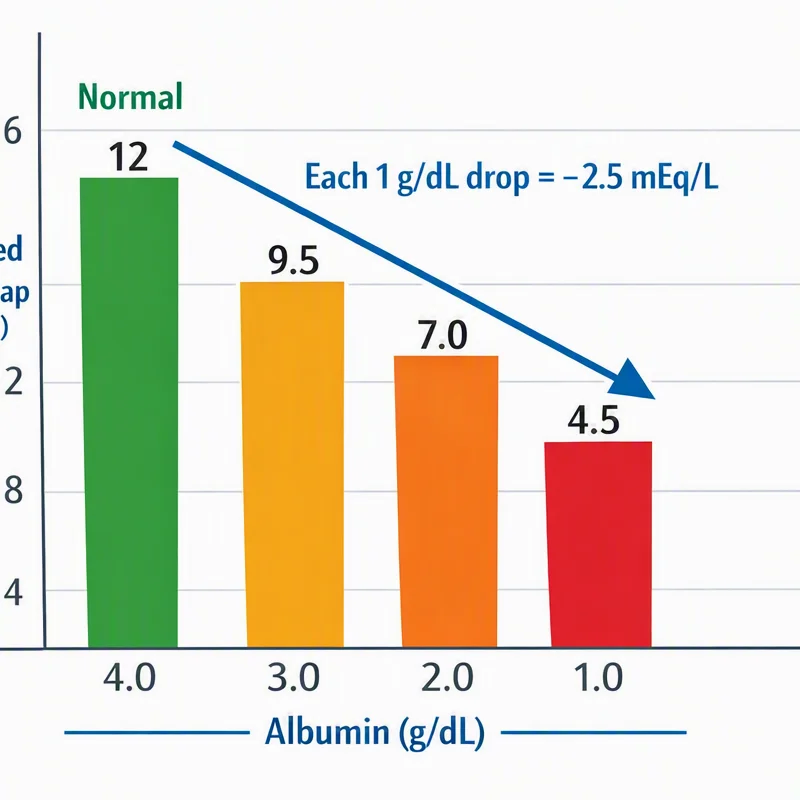
Albumin also matters. Since albumin is a major negatively charged protein in the bloodstream, low albumin can decrease the calculated gap and make the result look less concerning than it really is. That is why many clinicians use an albumin-corrected anion gap for more precise result interpretation. In other words, the calculator gives a starting point, but not the final answer.
Can the anion gap help diagnose acidosis causes?
Absolutely. The anion gap is one of the most valuable tools for sorting out the cause of metabolic acidosis. It does not identify a disease by itself, but it helps classify acidosis into two major patterns: high anion gap acidosis and normal anion gap acidosis. That separation often shapes the rest of the workup.
A high gap usually means acids have built up in the blood, increasing unmeasured anions. A normal gap usually means bicarbonate has been depleted and replaced by chloride, which keeps the gap from rising. This is why the pattern matters so much for clinical interpretation. The same low bicarbonate level can stem from very different processes.
A blood gas is often used alongside the anion gap to confirm whether acidemia is present and whether compensation is appropriate. A blood gas helps show pH, carbon dioxide, and bicarbonate status, while the gap gives a clue about the underlying cause. Together, they improve the acid-base evaluation.
In practical terms, the anion gap helps answer three questions:
- Does the patient have metabolic acidosis?
- If so, is it high gap or normal gap?
- What additional testing should come next?
That makes it a strong diagnostic clue, but not a standalone diagnosis. The most accurate approach combines the gap calculation, the blood gas, and the patient’s story.
High anion gap acidosis: common causes
High anion gap acid-base disturbance happens when acids accumulate and consume bicarbonate. The usual causes are often recalled as a short list, but the practical differential diagnosis can be wider. Major causes include lactic acidosis, ketoacidosis, kidney failure, and toxins.
Lactic acidosis happens when tissues generate or clear lactate poorly. This can happen with reduced oxygenation, shock, severe infection, seizures, or other states of stress. The excess lactate acts as an unmeasured anion, increasing the gap. In many cases, a serum serum lactate level is one of the most useful next tests.
Ketoacidosis develops when fat breakdown accelerates and ketone production climbs. It may be seen in uncontrolled diabetes, prolonged fasting, alcohol use, or other metabolic stress states. Here, checking ketones is necessary because they often explain the acid load.
Kidney failure can also lead to high gap acidosis because the kidneys cannot clear acid properly. As renal function worsens, acids amass and bicarbonate drops. This is a typical example of acid-base imbalance that may look subtle at first but becomes more obvious with worsening clinical interpretation of the chemistry profile.
Toxins are another major category. Some ingestions create unusual acids or alter normal metabolism, leading to marked gap elevation. Because some toxic causes can be time-sensitive, a careful history is vital, and toxic exposures should remain part of the differential diagnosis whenever the pattern does not fit the usual explanations.
High-gap patterns often point to the presence of extra acid, not just bicarbonate loss. That is why the anion gap is so important: it helps identify a problem that may not be obvious from the electrolyte panel alone.
Typical anion gap acidosis: common causes
A non-anion-gap acidosis, also called chloride-responsive acidosis, usually means bicarbonate has been lost and replaced by chloride. The gap stays “normal” because the fall in bicarbonate is matched by a rise in chloride, producing a chloride shift that keeps the calculation stable.
One common cause is diarrhea. When the gastrointestinal tract loses bicarbonate-rich fluid, the body becomes more acidic. This is often described as gastrointestinal bicarbonate loss. In these cases, chloride often rises as the body attempts to maintain electrical neutrality, which is why the acidosis does not necessarily produce a high gap.
Another important cause is renal tubular acidosis. In this condition, the kidneys do not handle acid and bicarbonate normally, so bicarbonate is lost or acid is retained despite a preserved or near-preserved glomerular filtration rate. Depending on the type, potassium abnormalities may also be present, making a careful workup important.
Hyperchloremic acidosis is a useful label because it describes the pattern rather than the cause. That pattern points clinicians toward GI losses, renal tubular problems, or other states where bicarbonate is depleted but unmeasured anions are not the main issue. This is a very different diagnostic pathway from high-gap acidosis.
So, if the gap is normal but the patient has low bicarbonate and acidemia, acidosis is still possible. The key is not to stop at the gap value alone. Instead, interpret it in the context of the blood gas, chloride level, and the overall metabolic picture.
Interpreting anion gap with albumin correction
Albumin is a key negatively charged protein and has a major effect on the calculated gap. When albumin is low, the anion gap can appear falsely normal or only mildly elevated even when a true acid-base problem exists. This is why hypoalbuminemia can conceal important changes.
An albumin-corrected anion gap adjusts the calculation to consider reduced protein binding and the loss of albumin’s negative charge contribution. This correction can expose hidden acid-base disorders that would otherwise be missed. In patients with low albumin, especially those who are ill or hospitalized, correction improves accuracy and supports better result interpretation.
The logic is clear: less albumin means fewer measured negative charges in the baseline calculation. Without correction, the gap may miss the true burden of acids or unmeasured anions. With correction, the clinician gets a more realistic picture of the acid-base state.
Albumin adjustment is especially helpful when the numbers do not fit the clinical picture. For example, a patient may have a alarming blood gas, low bicarbonate, and signs of systemic illness, but only a mildly abnormal gap. If albumin is low, the corrected value may reveal a more significant abnormality.
In short, albumin correction strengthens the quality of clinical interpretation. It does not substitute for judgment, but it helps avoid overlooking important metabolic acidosis.
Constraints of anion gap in diagnosis
Even though the anion gap is highly helpful, it has significant limitations. One important issue is multiple acid-base disorders. A patient can have several process happening simultaneously, such as elevated anion gap metabolic acidosis plus alkalosis from vomiting, or a normal-gap acidosis with another disorder added on. In those situations, the gap may look less pronounced than expected.
Lab variation is another limitation. Different analyzers, methods, and reference ranges can produce slight shifts in the calculated value. A number that seems slightly abnormal in one lab may be considered normal in another. That is why the exact lab reference interval should be interpreted according to the individual laboratory.
The delta-delta gap can help identify mixed disorders by comparing the rise in anion gap with the fall in bicarbonate. If those changes do not match well, it may suggest another acid-base process is present. This is useful, but it requires precise calculation and should still be integrated with the overall clinical picture.
The biggest limitation is that the anion gap cannot diagnose the cause on its own. It is a indicator, not a conclusion. Symptoms, medication history, kidney function, blood gas findings, and exposure history all matter. That is why the best results come from combining the gap with clinical context and the broader metabolic assessment.
How to order extra tests
Further tests are often required whenever the gap is abnormal. or the patient looks quite sick. If the concern is elevated gap acidosis, the next-step testing usually includes serum lactate, ketones, an arterial blood gas, and sometimes a toxicology screen. These tests help identify the cause and gauge severity.
A serum lactate level is especially important when sepsis, shock, tissue hypoxia, or another form of poor perfusion is suspected. Elevated lactate supports lactic acidosis and may indicate urgent treatment needs.
Ketones help confirm or exclude ketoacidosis. Depending on the scenario, urine ketones or serum beta-hydroxybutyrate may be more useful than a basic screen. If diabetes, fasting, alcohol use, or starvation is suspected, ketone testing is a central part of the workup.
An arterial blood gas is valuable when the acid-base picture is unclear or when respiratory compensation needs to be measured accurately. It helps show the pH and carbon dioxide level, which corrected anion gap with albumin are essential for complete acid-base evaluation.
A toxicology screen may be needed when ingestion is possible or when the gap is high without an obvious reason. Some toxins can create severe metabolic acidosis, and early identification can affect management.
Other tests may also be appropriate, such as kidney function studies, glucose, and targeted imaging, depending on the clinical picture. The key is that an abnormal gap should trigger purposeful next-step testing rather than be treated as a final diagnosis.
FAQ: Anion gap and acidosis
What can an anion gap show in acidosis?
The anion gap shows whether the low bicarbonate state is more in keeping with high anion gap or normal anion gap acidosis. It helps identify whether extra acids or bicarbonate loss is likely producing the problem. In other words, it is a practical tool for acid-base evaluation and differential diagnosis, not a diagnosis by itself.
Does a high anion gap always mean metabolic acidosis?
No, not always. A large gap often points to metabolic acidosis, but mixed disorders can distort the expected pattern. It should be read with the blood gas, bicarbonate, and clinical context. The gap is a major clue, but it is not enough by itself to confirm the exact disorder.
Can a normal anion gap still indicate acidosis?
Absolutely. A normal gap can also be seen in acidosis, especially in normal anion gap or hyperchloremic acidosis. Common examples include diarrhea, renal tubular acidosis, and other causes of GI bicarbonate loss. A low bicarbonate level with a normal gap still calls for a full acid-base workup.
Why do you correct the anion gap for albumin?
The gap is corrected because albumin provides negative charge to the calculation. In hypoalbuminemia, the raw number may downplay the true abnormality. An albumin-corrected anion gap improves accuracy and helps detect hidden acid-base disorders.
What tests should follow an abnormal anion gap?
Typical next tests include serum lactate, ketones, an arterial blood gas, and a toxicology screen. The exact workup depends on the pattern, symptoms, and suspected cause. These tests help confirm the diagnosis, find the driver of the acidosis, and direct treatment.